
Blumen verkaufen über 5 Sekunden Entscheidung.

WENN PREISLOGIK, BLICKFÜHRUNG UND REFILL STIMMEN, STEIGT MITNAHME SOFORT – OHNE MEHR FLÄCHE.

Die meisten Blumenflächen scheitern nicht am Sortiment, sondern an zwei Alltagsproblemen:

  • 1

    (1) Kunden verstehen in 5 Sekunden nicht, was sie kaufen sollen (Preis/Anlass/Qualität) – und laufen weiter.

  • 2

    (2) Die Fläche kippt nach 2 Stunden (leer, unruhig, gemischt) – und wirkt nicht mehr „frisch“.

Ein guter Blumenbereich ist im Kern kein „Blumenregal“, sondern ein Mini-Merchandising-System:

Auf dieser Seite zeigen wir die 5 Entscheidungen, die Profi-Märkte treffen – und welche Eco-Retail-Bausteine das im Alltag leicht machen.

Decision 1

What does the surface represent: a special occasion or everyday carry-on?

Flowers are not "a single product category." There are two modes of purchase: occasion (gift) vs. everyday consumption. Mixing the two creates a lack of clarity.

  • Everything is mixed together → seems arbitrary
  • Customers hesitate ("What fits?")
  • The best items don't sell through

Eco Retail building blocks for this

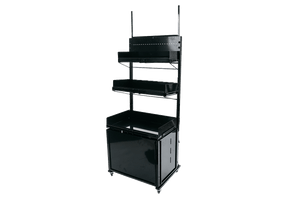
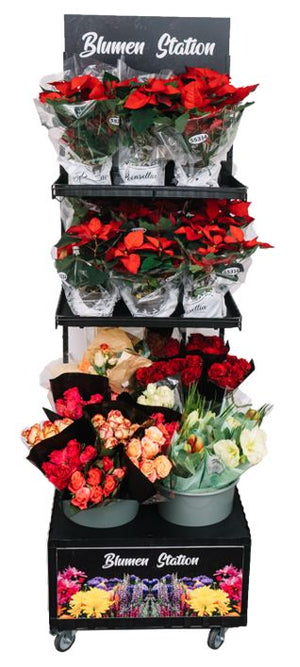
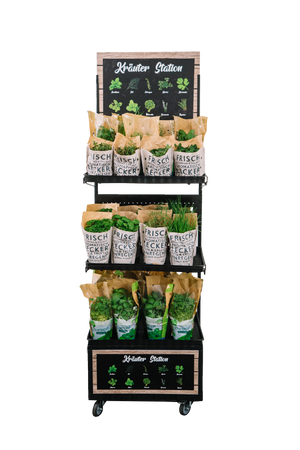
Concept Station

clear level logic for each occasion

Articles & Signage

Make the occasion clear: “Thank you”, “Love”, “Gift”

Presentation island / table

for the occasion hero

Decision 2

Pricing architecture: 3 clear price anchors instead of a forest of signs

Flower displays work when customers immediately see three things: "Cheap / Standard / Premium". Not 12 signs, but 3 price anchors.

  • Too many price tags → looks cheap/busy
  • No premium anchor → lower shopping cart value
  • Employees explain price instead of area

Eco Retail building blocks for this

Signage / Inserts / Price anchors

fixed system

Trays/Inserts

Group product categories: Clearly separate price levels

Basket solution

Premium visually stand out

Decision 3

Eye contact: "The hero" must have an effect from 3 meters away.

If the space only looks "beautiful" up close, it won't sell. A professional setup always has a hero spot (one eye-catcher) that stops customers.

  • The surface looks "uniform" → nobody stops.
  • No clear direction of gaze → hardly any impulse
  • "Fresh" only seems to work when you're standing in front of it.

Eco Retail building blocks for this

Presentation island with rattan baskets

Hero spot

Basket stand

3 baskets) (vertical line of sight)

Toppers/Signs

Name the hero: "Fresh today", "Seasonal", "Promotion"

Decision 4

Refill routine: the surface must never "tip over".

Flowers will fall off if the surface becomes empty/busy after 2 hours. This is not a design problem, but a problem with the refill system.

  • Some varieties are empty → “holey” image
  • Employees are constantly rearranging things.
  • Optics tilt between two deliveries

Eco Retail building blocks for this

baskets/boxes

quick replacement without rebuilding

Transport / Vehicle

Backstock → Area in a passage

Trays/Inserts

Order remains stable

Decision 5

Season mechanics: Win peaks without rebuilding each time

Flowers are peak-driven (Valentine's Day, Mother's Day, All Saints' Day, Christmas). Winning markets have a setup they simply "relabel and restock".

  • Every event = new chaos
  • Finished too late, too little space, wrong story
  • Remaining stock remains.

Eco Retail building blocks for this

Concept Station

Topic change via slider

Smart Display

additional peak area, rollable

Signage/Inlays

Event story in seconds